Welcome to my tales of cookery school, food and travel

The first 30+ posts of this blog describe my experiences as I complete a nine month cooking course - the City and Guilds Diploma in Food Preparation and Culinary Art. I did this after I moved out of full time employment and it was purely selfish - I love food, cooking, eating and drinking. Subsequent posts are about, food, travel and adventures.

Sunday, 10 July 2016

Stockholm syndrome

While we weren't kidnapped in Stockholm we were captivated - another very cool Scandinavian city. 

Stockholm from City Hall tower

As with Helsinki, I was here 36 years ago and this time my 'wanna see again' pick is the warship the Vasa. The Vasa was built on the orders of King Gustavus II between 1626 and 1628. He had an expansionist strategy that included a war with Poland and the Vasa was to be the flagship. 
A scale model of the Vasa

However it turned out to be a good example of the Emperor's new clothes. The King, busy at war, kept sending the shipbuilders instructions that made the ship less stable - she carried two enclosed gundecks with brass cannons, had a high stern to allow for boarding other ships, and a narrow hull which couldn't carry enough ballast, all making the upper structure too heavy. 

The shipbuilders didn't want to go against the King's instructions so no-one spoke up about the structural problems and the Vasa sank on her maiden voyage. About 1300 metres out from the dock a light breeze was enough to capsize her, and there she lay for the next 333 years. A good case study and more info here


The Vasa in 1980, yet to undergo any significant restoration
In 1961 she was recovered, largely intact, and housed in the Vasa Shipyard, where I saw her in 1980. For almost 20 years they had been spraying the ship with a preservative solution and I still remember the smell. There wasn't a lot to see at that time except for the ship itself and I was keen to see what progress had been made. 

In 1988 the ship was moved to the very fabulous Vasa museum, where we saw her more or less fully restored.  Just the sight of the ship itself is breathtaking - she's a huge galleon and the restoration is meticulous.  It is easy to spend a half day at the museum, such are the excellent story boards, displays and detailed information on everything from the shipbuilders selection of the trees for the build, the intricate carving and paintings on the hull, through to the food and drink carried on board. Incidentally, along with my photos I found the entry ticket from 1980 - it cost 3SEK - Swedish Kroner - this year we paid 130SEK. 
The Vasa now - see the museum site for better pics
Also historical and almost as fascinating is a tour of Stockholm City Hall, the home of the Nobel award ceremonies. We find Blå hallen - the Blue Hall - where the awards dinner takes place, isn't blue (just as the Red Square isn't red); the Gyllene salen - the Golden Hall with its 18 million gold mosaic tiles is gold, and as ornate as any we have seen.  It is amazing that they cram 1300 guests into the dinner.  We are told there is a strict measure for the amount of room between each seat, and it seems there's barely enough room for the 210 wait staff to move. They must select them for their slim physiques!  If you would like to recreate the place setting for the Nobel dinner, you will need the specially designed dinner set. 
Setting the table for your Nobel guests 
Elsewhere in Stockholm is the Nobel Museum, home to all things historic and current related to Alfred Nobel, the prizes and winners. We searched out our very own New Zealand Laureate Ernest Rutherford. This took a little bit of doing as we were searching under Physics - after all he is known as the father of nuclear physics - but in 1908 he received the Nobel prize in Chemistry.  again, the museum is well laid out, very information rich and with interactive elements that engage the visitor. Well done Stockholm.

We end our Nobel day with a delicious dinner at a cellar-like bar called The Hairy Pig - what could be less appropriate?  Who needs a Nobel dinner set?


Wednesday, 6 July 2016

That's the Finnish

From Russia we arrive in a country where we recognise the alphabet, even if we haven't a clue what the words mean. Finnish has a surplus of vowels, doubling up and sometimes using all five in one word. Playing scrabble here must be the only place in the world where you are thrilled to have four of the letter 'u' to use.  Finland and Croatia could engage in a vowels for consonants swap. 

I am excited to return to Helsinki after 36 years and find the old downtown part substantially the same, but with lots more tourists and an abundance of cruise ships (the last bit is not so exciting). When here in 1980 I fell in love with Finnish glassware and bought four iitala (there's those extra vowels) wine glasses and four schnapps glasses and, rather amazingly, carried them in my backpack through the rest of Scandinavia and back to London. Even more surprisingly, only one wine glass has broken over the years - and that was in an earthquake. Yet more astoundingly I find a replacement in the iitala shop in their 'classic' section. There's longevity of design for you. 


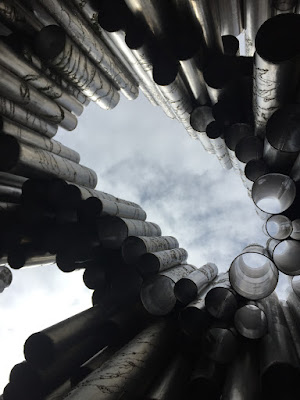
One of the things that brought me back is the monument honouring the Finnish composer Johan Sibelius. For 36 years this has been one of my most enduring travel memories. No, I'm not a fan of his music, but I am a fan of the sculptor's work. This is a stunning, stunning piece, and while the popular belief is that it resembles an organ the sculptor, Eila Hiltunen, was inspired by nature and the forest (as was Sibelius). 


from below

Except for getting to the 300 islands that form part of the city, Helsinki is very walkable - as long as you have a raincoat and umbrella.  Fortunately we took a boat trip the afternoon we arrived, for it rained most of the next four days (though luckily it was a fine afternoon to visit Sibelius).  

From Sibelius Park we walked around the coast. There's a lot of coast and a lot of boats which the hunter-gatherer has to stop and look at. Imagine my delight as we find marina after marina. What is far more interesting is a rug washing station. 

The Finn's tend to the pine floor with rugs style of interior design and wall to wall carpet is rare.  Rather than hire a rug cleaner, in Summer Finns gather up their rugs and eco friendly carpet shampoo and head to the beach.  Oh yeah, I kid you not. This is a very old tradition. We must've been too early in the season in mid June as the h-g had free rein on the wringer and there was only one rug hanging out.
The h-g ready to wring out 

one is the loneliest number 
 But these photos I took in July 1980 show locals hard out rug scrubbing. It really is a thing. 


After an energetic day scrubbing there is nothing like good meal of reindeer.  And although we did no scrubbing, Rudolph wasn't safe from us. We went to a Lapp restaurant which we were assured served traditional food but was heavy on the tourist trap aspect (as the prices in Euro rather than Finnish marks would suggest) .  

As long time readers of this blog know, I have a particular aversion to fruit and meat in combination so it will come as no surprise the menu below caused me some angst. Berries and berry sauce all over the place. 


We settled on the Lappish Game Selection - roasted elk, reindeer sausage, and braised reindeer. Clearly a very meaty meal, but there was nothing special about either the food or the presentation. Being lean meat it is prone to dry out and that was the case. While the h-g liked them, I could have done without the berries on the side!

Lappish game selection - tasted a bit better than it looks!
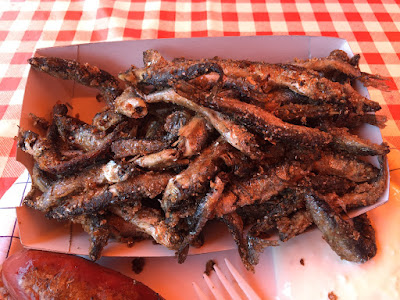
Our favourite food was found in the market that runs daily in the square by the harbour - more deep fried little fishes, rather less elegantly presented than the walnut crumbed smelt with gazpacho sauce we had in St Petersburg at the fancy restaurant, but just as delicious. 

lunch - twice (looks redder than it is because of the colour of the tent)

It's not just all this scrubbing and reindeer that makes the Finns one of the happiest countries, it's also the social policies. Although I am sure no-one is too thrilled about paying an average of 54% tax, I'm sure they are more excited about the generous health, education, pension, parental, child care, and annual leave provisions.  Total social protection expenditure relative to GDP is higher in Finland than any other country in the UE. 

And so we move on, taking the overnight floating duty free store from Helsinki to Stockholm - but that's the next instalment.